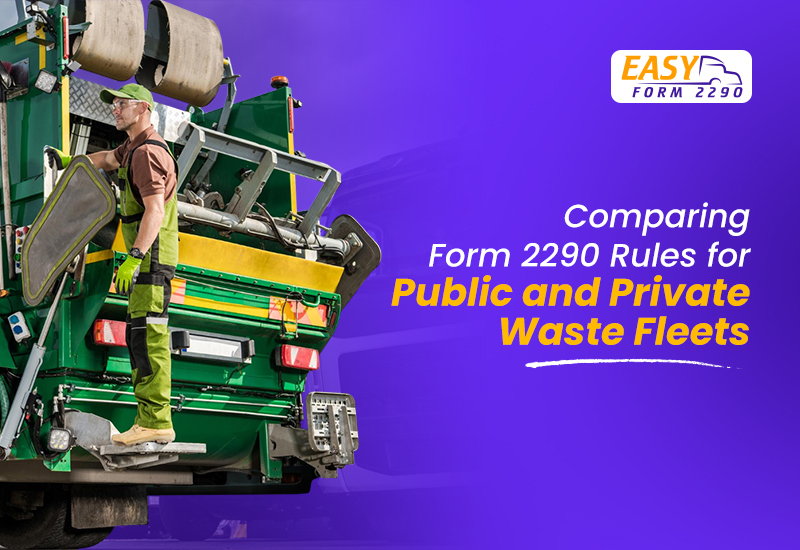


- 1) Form 2290 waste fleets must file annually for taxable heavy vehicles exceeding 55,000 pounds.
- 2) Public waste fleets may qualify for limited IRS exemptions under government ownership regulations.
- 3) Private waste fleets usually pay HVUT based on taxable gross vehicle weight classifications.
- 4) Accurate VIN records, mileage tracking, and deadlines help avoid costly IRS filing penalties.
- 5) Electronic filing allows Form 2290 waste fleets to receive Schedule 1 copies faster.
Why Filing Rules Differ Between Public and Private Fleets
It is common for waste collection vehicles to operate on public roads. Some of these vehicles may weigh more than the IRS taxable weight limit. As a result, many sanitation vehicles must file Form 2290 annually as part of the Heavy Vehicle Use Tax (HVUT) filing requirements.
However, public and private waste operators do not always follow the same filing rules.
Public waste fleets are typically owned by local government entities such as cities or sanitation departments. Some government-operated vehicles may qualify for IRS tax exemptions if the ownership and operational use meet IRS requirements.
Private waste fleets operate differently. Independent garbage collection companies, recycling contractors, and commercial sanitation providers are generally required to file Form 2290 and pay HVUT for heavy vehicles used on public highways.
Understanding these distinctions is important because incorrect exemption claims can result in IRS penalties and registration delays.
ALSO CHECK - The Ultimate Trucker's Guide to Driving Safely in Extreme Weather
Ownership Structure Decides Tax Responsibility
Vehicle ownership registration is one of the biggest factors in determining whether Form 2290 must be filed.
If a heavy vehicle is officially registered under a qualifying government entity, it may qualify for an HVUT exemption. However, this exemption only applies to eligible government-owned operations.
Cities that outsource sanitation services to private contractors generally cannot claim government exemptions. Vehicles operated by private waste contractors are usually still taxable.
Contractors managing municipal waste programs should carefully verify ownership documentation before filing. Filing incorrectly under exempt status may lead to rejected returns, IRS notices, and delays in obtaining Schedule 1 approval.
Businesses operating multiple vehicles should regularly review ownership records to avoid compliance risks.
Vehicle Weight Still Controls Tax Calculations
Regardless of whether the fleet is public or private, gross taxable weight determines Form 2290 tax obligations.
The IRS calculates gross taxable weight using:
- The weight of the vehicle itself
- The weight of the trailer
- The weight of the maximum load typically carried
Waste collection trucks often fall into higher taxable weight categories because of compactors, hauling equipment, and dense waste loads.
Commercial garbage haulers must ensure each vehicle is classified correctly. Filing under the wrong weight category can lead to amended returns and IRS corrections.
Accurate weight reporting also helps registrars process Schedule 1 copies more quickly for vehicle registration purposes.
Suspended Vehicle Rules Can Benefit Certain Fleets
Not every waste fleet vehicle automatically generates HVUT liability.
Vehicles driven 5,000 miles or less during the tax period may qualify for suspended vehicle status. Even when taxes are suspended, Form 2290 filing is still required.
This rule commonly applies to:
- Backup sanitation trucks
- Emergency-use waste vehicles
- Seasonal recycling units
- Reserve landfill support trucks
Many operators mistakenly believe low-mileage trucks do not require filing. In reality, suspended vehicles must still be reported to remain compliant with IRS requirements.
If a suspended vehicle exceeds the mileage limit later in the tax year, the fleet operator must amend the return and pay the required tax.
Filing Delays Can Disrupt Fleet Operations
Form 2290 deadlines are critical for maintaining uninterrupted fleet operations.
The form is generally due by the end of the month following the vehicle’s first use on a taxable highway.
Missing the deadline may result in:
- IRS penalties and interest
- Delays in vehicle registration renewals
- Compliance inspection issues
- Operational disruptions for fleet vehicles
Electronic filing helps operators receive stamped Schedule 1 copies quickly while reducing manual filing errors.
Fleet owners seeking a simplified filing process may consider using EasyForm2290 for secure online HVUT filing and faster Schedule 1 processing.
ALSO CHECK - 7 Common Truck Tax Problems and How Truckers Can Solve Them
Wrapping Up
Public and private waste fleets may both operate heavy vehicles on public roads, but their Form 2290 filing responsibilities can differ significantly, especially regarding ownership status and IRS exemptions.
Correct filing practices, accurate weight classification, and organized vehicle records help fleet operators avoid penalties and maintain uninterrupted operations.
Compliance with HVUT requirements is essential for sanitation businesses aiming to expand operations while remaining efficient and legally compliant.
Businesses operating taxable heavy vehicles may benefit from professional e-filing support to improve filing accuracy and simplify the Form 2290 process.
FAQs
1. Do government-owned waste vehicles always qualify for exemption?
No. Only eligible government-operated vehicles that meet IRS requirements may qualify for Form 2290 tax exemptions.
2. Can Form 2290 waste fleets report low-mileage trucks?
Yes. Qualifying low-mileage vehicles can be reported under suspended vehicle status rules.
3. What happens if a suspended vehicle crosses the mileage limit?
The fleet operator must amend the filing and immediately pay the required Heavy Vehicle Use Tax.